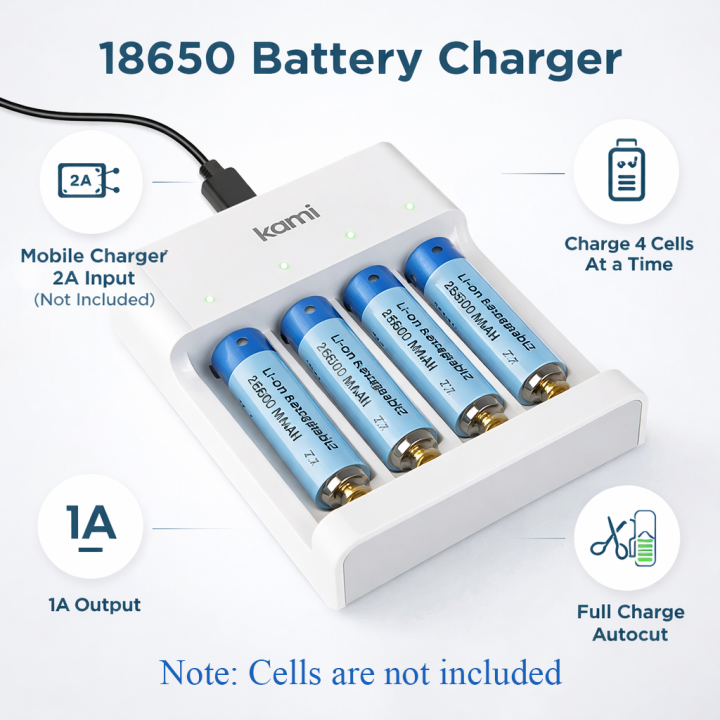
Lithium Battery Charger
A lithium battery charger is designed to charge lithium-based rechargeable batteries using a controlled charging process. Unlike older battery types, lithium batteries require the correct voltage, current, and charging method. Using an unsuitable charger can reduce battery life and, in some situations, create a safety risk.
Lithium batteries are now found in phones, laptops, power tools, electric bikes, scooters, solar storage systems, cameras, portable power stations, and many other devices. Although the batteries may look similar from the outside, their charging requirements can vary significantly.
The good news is that choosing the right charger does not have to be complicated. You mainly need to understand the battery’s chemistry, voltage, capacity, connector, and the charging specifications recommended by the manufacturer.
What Is a Lithium Battery Charger?
A lithium battery charger is an electronic charging device designed specifically for rechargeable lithium batteries.
The charger supplies electrical energy to the battery in a controlled way. It does not simply deliver a constant amount of electricity until the battery is full. Instead, a proper charger regulates voltage and current during different stages of charging.
Most rechargeable lithium-ion systems use a charging process commonly described as constant current followed by constant voltage (CC/CV).
During the constant-current stage, the charger supplies a controlled current while the battery voltage increases. Once the battery reaches its specified voltage limit, the charger holds the voltage and allows the charging current to gradually decrease.
When the battery reaches the manufacturer’s full-charge conditions, the charging process should stop or enter an appropriate standby state.
That controlled process is one reason you should not assume that any power adapter can safely charge a lithium battery.
Why the Correct Charger Matters
Lithium batteries are sensitive to charging conditions. A charger with the wrong output voltage may fail to charge the battery properly or, in a poorly designed system, create a dangerous condition.
For example, a battery designed for a particular voltage range needs a charger whose output matches the manufacturer’s specifications. A charger intended for a different battery pack may have a different voltage or charging profile.
Current also matters.
A charger capable of delivering a higher current is not automatically better. The battery and its battery-management system (BMS) must be designed to accept that charging rate.
The safest approach is simple: follow the battery or device manufacturer’s charging specifications rather than choosing a charger based only on the connector or physical appearance.
Types of Lithium Batteries
“Lithium battery” is a broad term. Several lithium-based chemistries exist, and their charging requirements are not necessarily identical.
Lithium-Ion
Lithium-ion batteries are widely used in consumer electronics, power tools, electric vehicles, and energy-storage equipment.
They commonly use a CC/CV charging method, but the exact voltage depends on the particular cell chemistry and battery design.
Lithium Polymer
Lithium-polymer batteries, often called LiPo batteries, are common in drones, RC equipment, portable electronics, and other applications where flexible battery shapes are useful.
They require chargers specifically suited to the battery pack and its cell configuration.
Lithium Iron Phosphate
Lithium iron phosphate, or LiFePO4, is another lithium-based chemistry. It is commonly used in some solar storage systems, recreational vehicles, backup power equipment, and other applications.
A charger designed for a conventional lithium-ion battery should not automatically be assumed to be suitable for a LiFePO4 battery. Their charging voltage requirements differ.
How to Choose a Lithium Battery Charger
Before purchasing a charger, check the battery label, manufacturer’s documentation, or device specifications.
1. Check the Battery Voltage
Voltage is one of the first specifications to verify.
A battery pack may have a nominal voltage and a separate maximum charging voltage. These numbers are not necessarily the same.
For example, a battery may be described by its nominal voltage while the charger is specified according to its maximum output voltage.
Always match the charger to the manufacturer’s specified charging voltage rather than guessing from the nominal rating.
2. Check the Battery Chemistry
Determine whether the battery is lithium-ion, LiFePO4, lithium-polymer, or another lithium chemistry.
The chemistry affects the appropriate charging voltage and charging profile.
This is particularly important when replacing an original charger. Two batteries with similar physical dimensions can have completely different charging requirements.
3. Check Charging Current
Charging current is measured in amperes (A).
A battery manufacturer may specify a recommended charging current or maximum charging current. Stay within those limits.
A slower charger may take longer, but faster is not necessarily better for battery longevity or safety.
4. Check the Connector
The connector must physically fit the battery or charging port, but that is only the beginning.
Two connectors can look identical while being wired differently or designed for different voltage levels.
Never choose a charger solely because its plug fits.
5. Check Polarity
For chargers that use barrel-style connectors or other DC plugs, polarity matters.
Connecting positive and negative incorrectly can damage electronics or create a hazardous situation.
Check the manufacturer’s specifications before connecting an unfamiliar charger.
6. Consider the Battery Management System
Many lithium battery packs include a battery management system (BMS).
A BMS can monitor factors such as voltage and temperature and may provide protection against conditions such as overcharging, over-discharging, and excessive current.
However, a BMS does not mean you can use any charger. The charging equipment should still be compatible with the battery pack.
How to Charge a Lithium Battery Safely
Charging procedures vary by battery and device, so the manufacturer’s instructions should always take priority.
A general safe approach is:
- Inspect the battery and charger before use.
- Check that the charger is designed for the battery’s chemistry and voltage.
- Make sure the connector and polarity are correct.
- Place the battery on a stable, non-combustible surface where appropriate.
- Keep the charging area properly ventilated.
- Follow the manufacturer’s instructions for charging.
- Disconnect the charger according to the manufacturer’s recommended procedure.
- Stop using the battery if it becomes unusually hot, swollen, damaged, or develops an unusual smell.
Do not charge a visibly damaged or swollen lithium battery unless a qualified professional has determined that it is safe to do so.
Can You Leave a Lithium Battery on the Charger?
It depends on the device and charging system.
Modern electronics often have sophisticated charging controls, but that does not mean every lithium battery setup is designed to remain connected indefinitely.
For consumer devices, follow the manufacturer’s guidance. For removable battery packs, power-tool batteries, e-bike batteries, and other standalone systems, use the recommended charger and charging procedure.
If the manufacturer specifically advises against unattended charging, follow that instruction.
Common Lithium Battery Charging Mistakes
Using a Charger With the Wrong Voltage
This is one of the most serious mistakes. A charger should meet the battery manufacturer’s voltage requirements.
Choosing a Charger Only Because the Plug Fits
A matching connector does not prove electrical compatibility.
Always check voltage, current, polarity, chemistry, and manufacturer requirements.
Charging a Damaged Battery
A swollen, cracked, leaking, severely damaged, or unusually hot lithium battery should not be treated like a normal battery.
Stop using it and seek appropriate professional guidance.
Charging in Extreme Temperatures
Battery charging performance can be affected by temperature. Some battery systems specifically prevent charging outside their permitted temperature range.
Follow the battery manufacturer’s temperature limits.
Buying an Extremely Cheap Unverified Charger
Price alone does not determine charger quality, but an unknown charger with unclear specifications is a poor choice for a lithium battery.
Look for clear electrical ratings, compatibility information, and a reputable manufacturer or supplier.
How Long Does a Lithium Battery Take to Charge?
There is no single charging time for all lithium batteries.
Charging time depends on factors such as:
- Battery capacity
- State of charge
- Charging current
- Battery chemistry
- Battery temperature
- Charger limitations
- Battery-management system
- Age and condition of the battery
A simple approximation is:
Charging time ≈ battery capacity ÷ charging current
For example, a theoretical 10 Ah battery charged at 2 A would take around 5 hours under ideal conditions. Real charging time can be longer because charging current normally changes as the battery approaches full charge.
This calculation should be treated as an estimate, not a substitute for the manufacturer’s charging specifications.
Does Fast Charging Damage Lithium Batteries?
Fast charging does not automatically mean a battery will be damaged.
Modern batteries and charging systems can be designed to support relatively high charging rates. However, charging at higher rates can increase heat and may contribute to greater battery wear depending on the battery design, temperature, charging conditions, and other factors.
If the manufacturer provides a maximum charging rate, stay within that limit.
Using a more powerful charger does not automatically make an incompatible battery charge faster.
Expert Tips for Better Lithium Battery Charging
Use the original charger when possible. The charger supplied with a device is normally selected to work with that system.
Replace lost chargers with verified compatible models. Match the electrical specifications rather than relying on appearance.
Keep batteries cool during normal storage and use. Excessive heat can negatively affect lithium battery performance and longevity.
Do not ignore physical damage. Swelling, unusual heat, smoke, leakage, or a strong chemical smell is a reason to stop using the battery.
Avoid mixing battery systems. A charger designed for one chemistry or voltage configuration should not automatically be used with another.
Read the label. Important information is often printed directly on the battery, charger, or device.
Frequently Asked Questions
What is a lithium battery charger?
A lithium battery charger is a charging device designed to supply the appropriate voltage and current to a rechargeable lithium-based battery using a controlled charging process.
Can I use any charger for a lithium battery?
No. The charger must be compatible with the battery’s chemistry, charging voltage, current requirements, connector, and polarity where applicable. Always follow the manufacturer’s specifications.
Is a lithium battery charger the same as a normal battery charger?
Not necessarily. Lithium batteries have specific charging requirements, and a charger designed for another battery chemistry may use a different charging method or voltage.
How do I know what charger my lithium battery needs?
Check the battery label and manufacturer’s documentation for chemistry, voltage, charging current, connector, and other requirements. If the information is unclear, contact the battery or device manufacturer rather than guessing.
Can I use a higher-amp charger for a lithium battery?
Not automatically. The battery and charging system must support the higher charging current. A higher-rated charger is not necessarily appropriate simply because it can provide more current.
How long does a lithium battery charger take to charge a battery?
Charging time varies with battery capacity, charging current, battery condition, temperature, and the charging system. The manufacturer’s estimated charging time is the best reference.
What should I do if my lithium battery becomes swollen?
Stop using and charging the battery. Do not puncture, crush, or attempt to repair a swollen battery. Follow local battery-disposal guidance or contact a qualified professional for safe handling.
Does a lithium battery charger stop charging automatically?
Many modern charging systems are designed to control the charging process and stop or reduce charging when the battery reaches its specified limits. However, the exact behavior depends on the charger and battery system.
Final Thoughts
Choosing the right lithium battery charger is mostly about compatibility rather than simply finding the fastest or cheapest option. Voltage, battery chemistry, charging current, connector, polarity, and the battery’s management system all matter.
When there is any uncertainty, the safest choice is to use the charger recommended by the battery or device manufacturer. Avoid damaged batteries and unknown chargers with unclear specifications, and follow the manufacturer’s charging and storage instructions.
A compatible charger not only helps the battery charge correctly but also supports reliable operation and safe everyday use.
About the Author